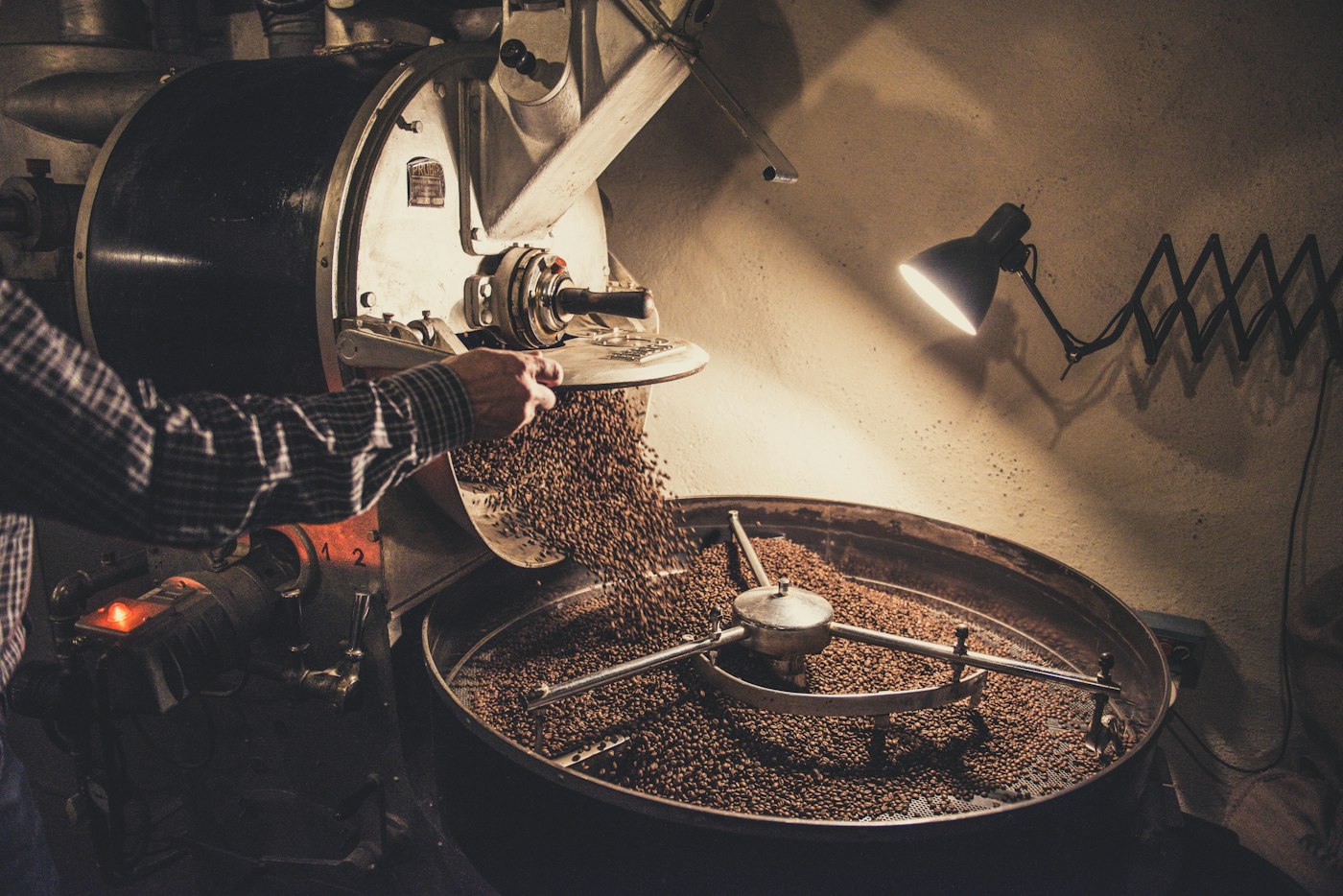
People ask what I do on a Tuesday and I usually say “roasting”, which is accurate and tells them almost nothing. What follows is the actual shape of the day, from the first sack of green coffee to the moment we decide whether the week’s work is good enough to sell. It is less romantic than the photographs suggest and considerably more interesting.
6:00 — Weighing out
I get in before the bar does. The building is cold and the only sound is the extractor spinning up. The first job is arithmetic: how much of each coffee we got through last week, what is resting, what is about to fall out of its window, and therefore what has to go through the drum today.
Green coffee is weighed into 4.8kg batches — a little under the 5kg the drum will technically take, because a slightly under-loaded drum gives me more control over the last ninety seconds, and the last ninety seconds are where everything is decided. On a normal Tuesday that is nine or ten batches: six of Kiln Street No. 4, the rest split between the two filter lots on rotation.
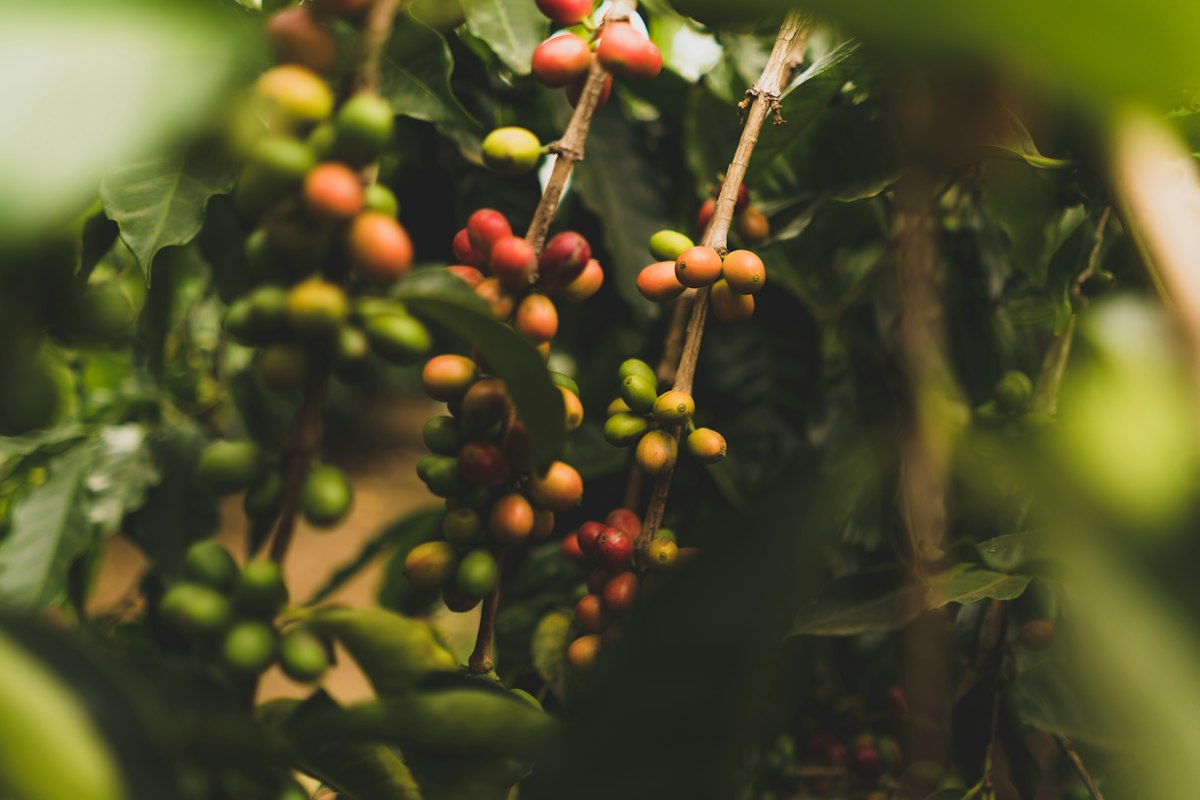
Green coffee, by the way, smells like hay and dried grass. Nothing about it suggests coffee. I have been doing this for a decade and it still seems slightly implausible.
6:40 — Bringing the drum up
The roaster is a 5kg drum machine that came here second-hand in 2016 and has done every bean we have ever sold. It needs about forty minutes to reach charge temperature and, more importantly, for the steel to be evenly hot all the way through. A drum that is hot on the surface and cold in the mass will roast the first batch completely differently from the fifth, which is why the first batch of the day is never sold.
We call it the warm-up batch. It is usually the tail end of last week’s green, it goes into the staff tin, and the baristas have strong opinions about it.
7:30 — The first real batch
Charge, and the temperature drops off a cliff as 4.8kg of room-temperature seed hits hot steel. Then you wait for the turning point — the moment the bean mass stops taking heat and starts giving it back — and from there the whole roast is a controlled argument between gas and time.
There are three phases and they matter in different ways:
- Drying (roughly 0–4:30). The bean gives up its remaining moisture. Nothing tastes of anything yet. Rush this and you get a roasted outside and a raw middle, which shows up in the cup as a flat, papery finish.
- Maillard (roughly 4:30–8:30). Sugars and amino acids start reacting, the beans turn from yellow to tan to brown, and the room begins to smell like toast and then like bread. This is where sweetness is built or lost.
- Development (from first crack to drop). The aromatics that people actually taste are formed here, and the window is short.
First crack arrives at around nine minutes and it is exactly what it sounds like: an audible, irregular popping, like a handful of gravel dropped on a tin roof, as steam fractures the bean structure. The first time you hear it you will grin. It never entirely stops being satisfying.
Where we drop, and why
This is the only genuinely opinionated part of the process, and it is where our coffee stops being generic and starts being ours.
| Coffee | Dropped | Roughly why |
|---|---|---|
| Kiln Street No. 4 (house blend) | ~1:50 after first crack | Body and cocoa sweetness that survives 150ml of steamed milk |
| Filter single origins | ~1:05 after first crack | Keeps the acidity and the aromatics that make a pour-over worth four minutes |
| Decaf Colombian | ~1:30 after first crack | Decaf beans are structurally fragile and colour early; timing lies, so I go by sound |
We drop the blend a little later than a lot of specialty roasteries would, and I will defend it. Our house blend exists to be drunk as a flat white, and a roast profile optimised for a black filter cup disappears entirely under milk. There is a fashion for very light roasting that I think occasionally forgets what the coffee is actually for. The filter lots get the light, bright treatment precisely because there is nothing to hide behind in a V60.
Every batch is logged — charge temperature, turning point, first crack time, drop time, weight loss — against the same batch from the previous week. If a number has drifted, I want to know why before I taste it, not after.
11:00 — The floor above wakes up
By late morning the bar is properly busy and the smell has worked its way up through the building. Guests in the Roastery Room are directly above the drum, which we warn people about at booking and which almost nobody objects to afterwards. It is, as one guest wrote in the book, the best possible alarm clock.
The last batches go through by about noon. Then the drum gets cleaned, which is nobody’s favourite hour of the week.
14:00 — The cupping table
This is the part that decides whether Tuesday counted.
Cupping is a deliberately unglamorous protocol: coarse grind, hot water, a crust that forms and is broken at four minutes, and a heavy spoon. We taste the morning’s batches blind against the same coffee from the previous week, scored on the things that actually matter — sweetness, acidity, body, aftertaste, and whether there is anything wrong with it.
Blind matters. If I know which cup is mine I will find reasons to like it. The point of the protocol, which is laid out properly by the Specialty Coffee Association, is to take my ego out of the decision.
Roughly once a month a batch does not make it. It goes to staff, or to the compost heap at the community garden two streets over, and I roast it again on Thursday. Throwing away eight kilos of coffee you personally roasted is character-building in a way I could do with less of.
4 to 7 days — Resting
Freshly roasted coffee is full of carbon dioxide. Pull a shot with beans roasted yesterday and you will get a thin, sour, unstable extraction as the gas fights the water — the puck literally erupts in the basket. So everything rests: four days minimum for filter, closer to seven for espresso.
And then the other end of the window. We do not serve anything past twelve days off roast. Not because coffee turns poisonous at day thirteen, but because the aromatics flatten and by day fourteen you are drinking a shadow of what we made. Every retail bag has its roast date printed on it precisely so you can hold us to that — details of which coffees are on at the moment are on our coffee page, and the current prices are on the full menu.
Come and taste it yourself
Every Saturday at 9am we put five coffees on the cupping table and anybody can join. It is free, it lasts about forty minutes, there is no jargon, and there is absolutely no obligation to like any of them. Guests staying upstairs are automatically welcome; everyone else just needs to let us know you are coming so we set out enough bowls.
Come once and you will never quite drink coffee the same way again. I consider that a fair warning.